Bridging Generations: A Veteran-to-Apprentice Blueprint for South Africa’s Future
A Nation Rebuilt by Hand, Heart, and Heritage
Bridging Generations: A Veteran-to-Apprentice Blueprint for South Africa’s Future
A Nation Rebuilt by Hand, Heart, and Heritage
South Africa’s greatest untapped resource is not buried beneath its soil—it lives in the minds and hands of the master artisans who built its railways, power grids, pipelines, and communication networks, and in the eager potential of a young generation waiting for the chance to learn.
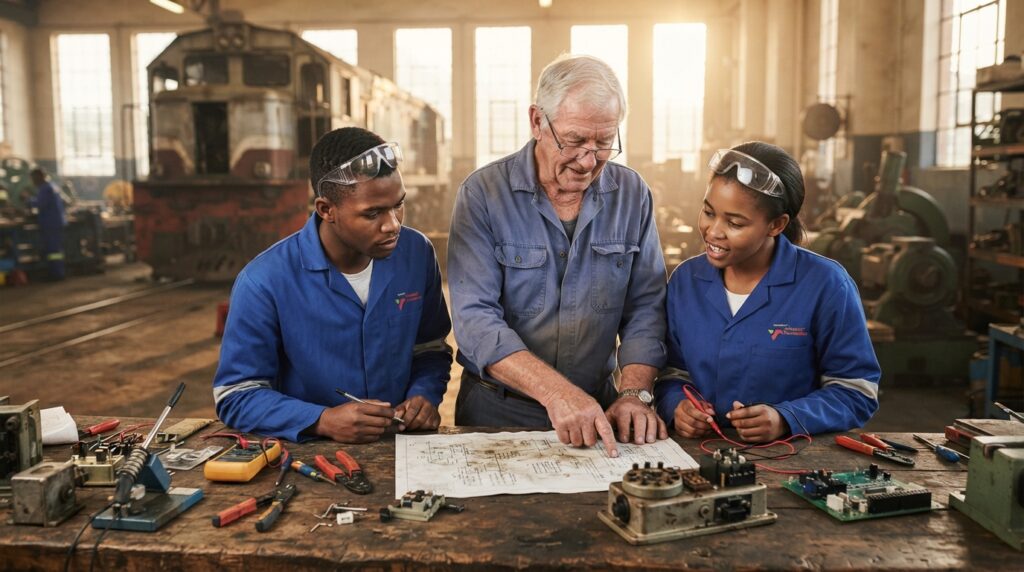
For decades, South Africa stood as an engineering powerhouse because generations passed their craft directly from master to apprentice. Today, as the nation works to restore its critical infrastructure and build a modern, self-reliant economy, no amount of imported machinery or policy alone can replace that human link. True industrial revival happens when experience meets opportunity—when seasoned specialists step forward not to look backward, but to light the path ahead for every young South African willing to work, learn, and build.
This initiative is dedicated to a simple conviction: that honoring the wisdom of our retired builders while equipping our youth with real, practical trades will create dignity, purpose, and lasting jobs for all who want them. By bridging generations, we do more than repair steel and wire—we shape a stronger, freer, and brighter future for South Africa.
Bridging the Skills Gap Through Mentorship
Rebuilding South Africa’s critical infrastructure and preparing a new generation for sustainable, meaningful employment requires more than new equipment—it demands the restoration of lost institutional memory. Across South Africa’s rail, telecommunications, and heavy industrial sectors, an entire era of hard-won engineering wisdom retired with the master artisans and specialists of the past.
While formal hiring frameworks and regulatory requirements can complicate bringing retired specialists back into full-time payroll positions, structured mentorship and knowledge-transfer programs offer a practical, high-impact pathway forward. By connecting veteran specialists with today’s apprentices, South Africa can bridge the skills gap, accelerate industrial recovery, and prepare young technicians for a modern, future-facing economy.
Why Master Artisans Are Essential to a Brighter Future
- Preserving Unwritten Field Knowledge: Textbooks teach theory, but veteran technicians hold the practical wisdom of how systems behave under real-world stress—from severe lightning and coastal corrosion to heavy-haul mechanical wear and complex fault diagnostics.
- Purpose Through Service: Re-engaging retired specialists gives seasoned engineers, boilermakers, electricians, and telecommunications technicians a renewed sense of purpose—turning decades of lived experience into a lasting legacy.
- Job Readiness for the Next Generation: Pairing young apprentices with master artisans builds troubleshooting confidence, safety discipline, and pride in craftsmanship—equipping every willing young South African with real-world skills that translate directly into long-term careers.
Four Practical Pillars for a Veteran-to-Apprentice Program
1. Partner with Existing Training Academies
Rather than building new institutions from the ground up, a mentorship initiative achieves the fastest impact by plugging directly into established technical pipelines:
- National rail and industrial training centers (such as the Transnet School of Rail campuses and PRASA technical centers)
- Public and private TVET colleges across provinces like KwaZulu-Natal, Gauteng, and the Western Cape
- Sector Education and Training Authorities (SETAs) focused on transport, manufacturing, and engineering
2. Hybrid & Remote “Masterclass” Clinics
Retired specialists living across South Africa—or anywhere in the world—do not need to stand on a factory floor full-time to transfer critical knowledge:
- Live Virtual Troubleshooting Clinics: Scheduled online sessions where veterans walk apprentices through real-world schematics, fault-finding logic, and safety protocols.
- Recorded Technical Walkthroughs: A growing video and audio library capturing rare diagnostic techniques before they are lost.
- Interactive Q&A Panels: Direct dialogue between retiring or retired specialists and current electrical, signalling, mechanical, and telecom trainees.
3. Mobilize Alumni & Heritage Networks
Former railway, telecom, and industrial apprentices already gather through strong informal and heritage networks—including regional rail preservation societies, workshop alumni groups, and veteran engineering associations. These communities provide an immediate, trusted starting directory to recruit willing mentors across every trade discipline.
4. Document “Field Rules” & Case Studies
Pairing veteran specialists with young apprentices to co-author practical troubleshooting guides turns lived experience into permanent training assets:
- Real-world failure-and-recovery case studies
- Practical safety and surge-protection checklists
- Step-by-step diagnostic workflows that prevent future generations from repeating costly mistakes
Moving Forward
A thriving, future-facing South African economy depends on honoring the foundations laid by its master builders while empowering the youth who will carry that work forward. Through structured mentorship, the wisdom of the past becomes the blueprint for a stronger, self-reliant future—creating real skills, real dignity, and real jobs for all who want them.
If you’d like, I can:
Add a call-to-action / contact block at the bottom so retired artisans and training colleges can reach out
Convert this combined page into clean HTML ready to paste into Freedomshaper.com
This initiative is dedicated to a simple conviction: that honoring the wisdom of our retired builders while equipping our youth with real, practical trades will create dignity, purpose, and lasting jobs for all who want them. By bridging generations, we do more than repair steel and wire, we shape a stronger, freer, and brighter future for South Africa.
Bridging the Skills Gap Through Mentorship
Rebuilding South Africa’s critical infrastructure and preparing a new generation for sustainable, meaningful employment requires more than new equipment—it demands the restoration of lost institutional memory. Across South Africa’s rail, telecommunications, and heavy industrial sectors, an entire era of hard-won engineering wisdom retired with the master artisans and specialists of the past.
While formal hiring frameworks and regulatory requirements can complicate bringing retired specialists back into full-time payroll positions, structured mentorship and knowledge-transfer programs offer a practical, high-impact pathway forward. By connecting veteran specialists with today’s apprentices, South Africa can bridge the skills gap, accelerate industrial recovery, and prepare young technicians for a modern, future-facing economy.
Why Master Artisans Are Essential to a Brighter Future
- Preserving Unwritten Field Knowledge: Textbooks teach theory, but veteran technicians hold the practical wisdom of how systems behave under real-world stress—from severe lightning and coastal corrosion to heavy-haul mechanical wear and complex fault diagnostics.
- Purpose Through Service: Re-engaging retired specialists gives seasoned engineers, boilermakers, electricians, and telecommunications technicians a renewed sense of purpose—turning decades of lived experience into a lasting legacy.
- Job Readiness for the Next Generation: Pairing young apprentices with master artisans builds troubleshooting confidence, safety discipline, and pride in craftsmanship—equipping every willing young South African with real-world skills that translate directly into long-term careers.
Four Practical Pillars for a Veteran-to-Apprentice Program
1. Partner with Existing Training Academies
Rather than building new institutions from the ground up, a mentorship initiative achieves the fastest impact by plugging directly into established technical pipelines:
- National rail and industrial training centers (such as the Transnet School of Rail campuses and PRASA technical centers)
- Public and private TVET colleges across provinces like KwaZulu-Natal, Gauteng, and the Western Cape
- Sector Education and Training Authorities (SETAs) focused on transport, manufacturing, and engineering
2. Hybrid & Remote “Masterclass” Clinics
Retired specialists living across South Africa—or anywhere in the world—do not need to stand on a factory floor full-time to transfer critical knowledge:
- Live Virtual Troubleshooting Clinics: Scheduled online sessions where veterans walk apprentices through real-world schematics, fault-finding logic, and safety protocols.
- Recorded Technical Walkthroughs: A growing video and audio library capturing rare diagnostic techniques before they are lost.
- Interactive Q&A Panels: Direct dialogue between retiring or retired specialists and current electrical, signalling, mechanical, and telecom trainees.
3. Mobilize Alumni & Heritage Networks
Former railway, telecom, and industrial apprentices already gather through strong informal and heritage networks—including regional rail preservation societies, workshop alumni groups, and veteran engineering associations. These communities provide an immediate, trusted starting directory to recruit willing mentors across every trade discipline.
4. Document “Field Rules” & Case Studies
Pairing veteran specialists with young apprentices to co-author practical troubleshooting guides turns lived experience into permanent training assets:
- Real-world failure-and-recovery case studies
- Practical safety and surge-protection checklists
- Step-by-step diagnostic workflows that prevent future generations from repeating costly mistakes
Moving Forward
A thriving, future-facing South African economy depends on honoring the foundations laid by its master builders while empowering the youth who will carry that work forward. Through structured mentorship, the wisdom of the past becomes the blueprint for a stronger, self-reliant future—creating real skills, real dignity, and real jobs for all who want them.
This page is proudly sponsored by:
Quantum United Development Trust.